Unexpected market crashes scare both expert and novice mutual fund investors to the core, but SIPs often turn out to be their saviors. Panicking during market crashes isn’t unusual because of the fear-mongering news of historical market downfalls, fluctuating return indicators and all.
Those who haven’t opted for SIPs often end up making significantly wrong decisions related to their investments that can even end their investment journeys. Such decisions mostly leave permanent dents in their investment portfolios, including massive financial losses that make it almost impossible to re-invest. That’s not the case with SIP investors. As an SIP investor, you know that you’re supposed to keep investing, no matter what goes on around.
Even during the worst kinds of market crashes, an advanced SIP return calculator projects your long-term returns accurately, assuaging your fear to a large extent. Deep down, smart long-term SIP investors trust what they’ve been taught, that is, market crashes eventually multiply long-term SIP returns. Do you believe the same and want to explore the practical reasons behind the fact? This blog will discuss why market crashes are long-term SIP return boosters.
The mutual fund SIPs you invest in purchase more units during market crashes, leveraging the cost reductions. When the market goes down, prices of fund shares also go down drastically. This is when novice shareholders see the overall prices of the stocks they hold dip all of a sudden. They panic, assuming that they’re bearing massive losses. To avoid a more intense dip in the mutual fund unit costs, they leave the market inconsiderately and end up bearing significant financial losses.
On the flip side, SIP mutual fund investors generally have no options other than staying invested, and that turns out to be a boon for them eventually. Market crashes affect the prices of share units, and the mutual funds these investors invest in buy as many extra share units as possible. Later, the prices of the same units go higher when the market stabilizes, and SIP investors earn massive profits.
Similarly, the mutual funds you invest in buy lower units when market prices shoot up. So, it’s a never-ending cycle of purchasing more units at lower prices and fewer units when prices hike. Eventually, this pushes you ahead of the market fluctuations due to rupee cost averaging. The effects of market volatility get balanced naturally, but only when you stay invested. So, market crashes are not actually disastrous, rather, they can be turned into great opportunities to multiply your returns if you know how to.
The magic of long-term SIP investments lies in the compounding factor, and a reliable SIP return calculator can track the compounding returns precisely. Market crashes may delay your returns in the worst-case scenario, but not deny them. The market always returns to normal, and unit prices ascend again. So, you’re bound to get your returns no matter what. The secret lies in staying invested.
Investors who pause their SIPs or leave the market during turbulence break the flow of the compounding effect. Even pausing your SIPs temporarily can affect your long-term returns. You don’t earn as much return as you were supposed to. Market crashes are actually a test of patience. Those who survive them end up securing overwhelming returns.
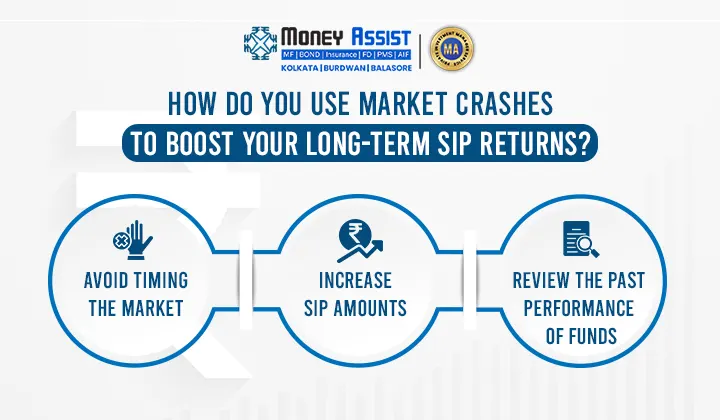
So far, the article has elaborate on how market crashes can open doors to greater returns. Now it comes to how you can seize the opportunity to multiply returns during these crashes. The following tips will help you in the best possible ways-
These smart hacks help ensure greater long-term SIP returns even when you’re through multiple market crashes. A precise SIP return calculator projects your probable returns accurately even during the worst market crashes. So, keep checking your probable returns, be patient and do the needful to maximize long-term returns.